Why sizing matters more than brand
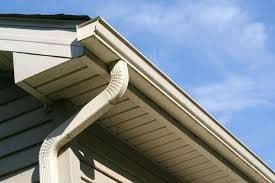
Standard 5-inch K-style gutters move about 5,500 square feet of roof drainage per downspout under normal rain. But in Maryland, "normal" rain isn't the issue — it's the 2-inch-per-hour summer thunderstorm. For homes with steep pitches, large roof planes, or only one or two downspouts, 6-inch gutters with 3x4-inch downspouts move roughly 40% more water and prevent the overflow that rots fascia, soaks foundations, and undermines walkways.
We recommend 6-inch gutters by default on most Maryland homes with architectural shingle roofs — the steep-pitch colonials we see on Crofton gutter jobs are the classic case.
Slope: the silent failure point
Gutters are not flat. They should slope about 1/4 inch for every 10 feet toward the downspout. Too flat and water sits, freezes in winter, and pulls the gutter off the fascia. Too steep and the gutter looks crooked from the curb.
When we re-hang a system, we use hidden hangers spaced no more than 24 inches apart, screwed into the rafter tails — never just the fascia board. Hangers driven only into fascia pull loose under the weight of a single ice storm.
Downspout placement
Downspouts should:
- Discharge at least 4 feet away from the foundation, ideally with an extension or buried drain line.
- Be located at inside corners when possible (water naturally collects there).
- Have one downspout for every 30–40 feet of gutter run.
A surprising number of Maryland basement leaks are not foundation problems — they're downspout placement problems. If your basement gets damp every spring and you have a single downspout dumping water 18 inches from the wall, the foundation is fine; the gutter system is the cause.
The Maryland seasonal maintenance schedule
Spring (March / April): Clear winter debris, check for ice damage at the eaves, and verify slope after freeze-thaw season has flexed the hangers.
Summer (June): Quick visual check after the first big thunderstorm — look for overflow points. Anywhere water sheets over the front edge in heavy rain marks a clog or an undersized run.
Late Fall (November): The most important cleaning of the year. Maryland's tree canopy drops most of its leaves in late October and November; clogged gutters going into winter cause ice dams that push water back under the shingles.
Winter (after a storm): Check for ice buildup at downspout outlets — frozen downspouts force water back up the gutter and under the roof edge.
Gutter guards: worth it or not?
Gutter guards work — but only the right ones, properly installed. Cheap plastic mesh collapses under wet leaves. Foam inserts hold moisture, rot the fascia, and grow algae. We recommend either micro-mesh stainless guards or reverse-curve guards, both pitched to shed debris naturally and rated for the heavy oak, maple, and pine debris common in Maryland yards — worst on the shaded lots we work in Severna Park.
Guards also do not eliminate cleaning entirely. They reduce annual cleanings from two-to-three down to roughly one inspection per year, but a good system still needs an eye on it every fall.
Five signs your gutter system needs more than a cleaning
- Water overflows the front edge in any moderate rain — that's a sizing or slope problem, not a debris problem.
- Visible gap between the gutter and the fascia — the hangers have pulled loose or the fascia behind them is rotting.
- Peeling paint or stained siding directly below the gutter line — water is escaping behind the gutter, not through it.
- Mosquitoes or standing water inside the gutter even days after a rain — the slope is wrong.
- Erosion or mulch washout below a downspout — the discharge point is too close to the home.
If you see any two of these, repair will not fix it. The system needs to be re-hung, re-sized, or re-routed.
What a proper Apper gutter installation includes
- A real measurement of roof area per drainage zone — not a guess based on linear feet.
- Seamless 5-inch or 6-inch K-style gutters, formed on-site to your run length.
- Hidden hangers screwed into the rafter tails every 24 inches.
- Slope set with a laser line, not by eye.
- 3x4-inch downspouts on 6-inch systems (the upsize that actually matters).
- Discharge extensions or buried drain tie-ins at every downspout.
- Optional micro-mesh guards installed pitched to the gutter face, not flat.
- A written workmanship warranty.
When to call us
If your Maryland home has overflow problems, sagging gutters, or a damp basement that nobody else has solved, the gutter system is usually the first place to look. We provide free on-site gutter evaluations across our service area in Anne Arundel, Baltimore, Howard, Montgomery, and Prince George's Counties — and we'll tell you honestly whether you need a cleaning, a re-hang, or a full new system.