
What an attic is supposed to do (and what most Maryland attics actually do)
A roof's job stops at the deck. The attic underneath is supposed to be a continuous, thermally neutral cavity — cooler than the conditioned house in winter, only slightly warmer than outside air in summer. That keeps the shingles from cooking, the rafters from sweating, and the moisture from condensing on the underside of the deck.
Most Maryland attics fail that test. In a 2,000 sq ft Severn rancher with one box vent at each end of the ridge, summer attic air can crest 140°F at three in the afternoon and sit there until well after sunset. That heat radiates down into the bedrooms below, the AC compressor runs longer, and the ceiling drywall gets warm to the touch.
The shingles above the attic age years faster than the same shingles on the shaded side of the roof. A 30-year shingle vented at 140° often performs more like an 18-year shingle. You paid for the warranty; the ventilation gave it back.
The two signs your attic is starving for air
Upstairs rooms 8-12° warmer than the first floor
If the upstairs is consistently hotter than the thermostat reading on the main floor, the attic isn't moving heat out. It's piping it down. A correctly vented attic stays within 15-20° of outside air. A broken one sits 50-60° above.
Frost on the underside of the roof sheathing in January
Pop the attic hatch on a clear cold morning and shine a flashlight at the roof deck — if you see frost crystals or dark wet stains on the underside of the plywood, that's interior humidity from showers, cooking, and laundry condensing on a cold roof deck where it has no business being. It looks small at first glance, and it rots sheathing inside three winters until the next roofer who climbs up there charges you for a deck replacement.
Ridge vent + soffit vent: why the pair beats either one alone
Attic ventilation is a system of intake (low) and exhaust (high). Hot air rises, escapes through the ridge, and pulls cooler outside air in through the soffits. Stack effect. Free physics.
A ridge vent without working soffit intake is half a system. It tries to exhaust without anywhere for replacement air to enter, so it either does nothing or pulls air from the living space through ceiling penetrations — which dumps your conditioned air into the attic.
A power attic fan with no soffit intake is worse. It actively depressurizes the attic and sucks conditioned air upward through every recessed light and bath fan, raising your AC bill while pretending to lower your attic temp.
The math the building code uses is the 1:300 rule — for every 300 sq ft of attic floor, you need 1 sq ft of net free vent area, split 50/50 between intake (soffit) and exhaust (ridge). Maryland residential code section R806 references the same target.
When power attic fans actively hurt you
If the soffits are blocked by old fiberglass batts pushed into the eaves — common in 1970s-80s Anne Arundel ranchers — adding a power fan amplifies the depressurization. Apper crews regularly find soffit baffles either missing entirely or crushed against the underside of the roof deck by blown-in insulation. The fix isn't a bigger fan. The fix is opening up the intake.
The Maryland twist — Chesapeake humidity in summer, ice dams in winter
Summer here isn't just hot. It's saturated, with dew points in late July routinely pushing 75°. That humid air sneaks into a poorly vented attic and stays there — sheathing absorbs it, mold finds it.
Winter brings the second half of the same problem. A warm attic over a cold roof melts snow on the upper shingles, and the runoff refreezes when it hits the cold overhang at the eave. That refrozen ridge dams water back under the shingles and into the ceiling below — a pattern Howard County homes with deep north-facing eaves see every February.
A correctly vented attic stays cold enough in winter that the snow doesn't melt unevenly. The same ridge-vent install that drops your July attic from 140° to 95° is what keeps your January roof from cooking off ice dams. One fix. Two problems.
"Several companies quoted me thousands of dollars just to add sealant — without even going up on the roof to investigate. Leandro was completely different. He and his team inspected the issue both inside the house and on the roof, and even used a drone in addition to an in-person inspection to pinpoint the problem. They discovered missing ridge caps, pipe collars, kick-out flashing, and more." — Raheem Persad, Maryland homeowner
That's the inspection a ventilation diagnosis actually requires — inside the attic, outside on the deck, and the soffits checked end to end. Not a curb-side guess.
What to ask any roofer before they replace your Maryland roof
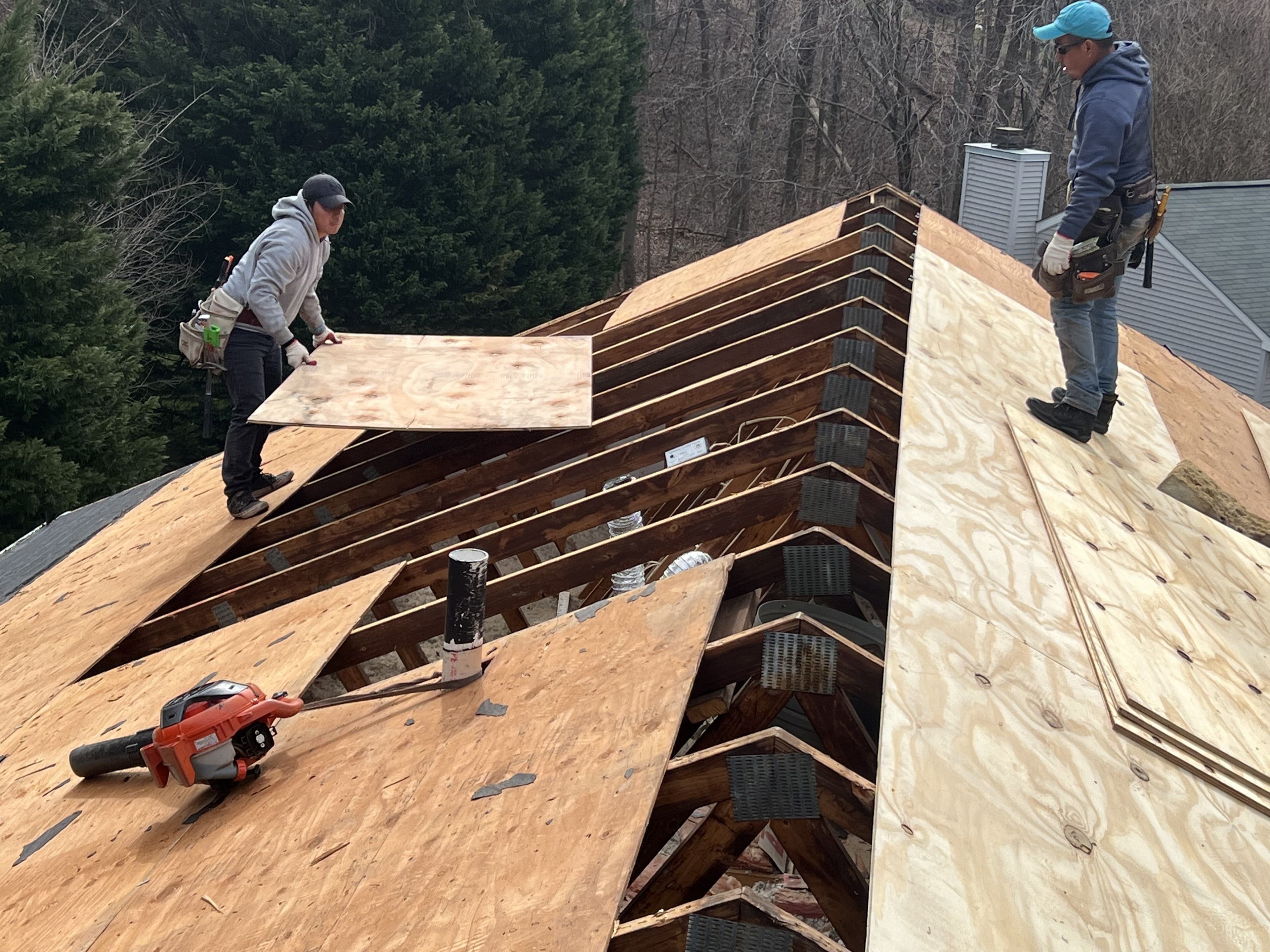
If you're already getting a roof replaced — that's the cheapest moment in the next 25 years to fix the attic. The shingles are off. The ridge is exposed. Adding continuous ridge vent and clearing the soffits adds a few hundred dollars to the job and pays back inside 2-3 cooling seasons.
Five questions to ask any estimator:
- What's the net free vent area of the current system, and the planned system?
- Are the soffits clear of insulation? Will baffles be added where they're missing?
- Will any old box vents or turbines be removed and the deck patched?
- Is bathroom or kitchen exhaust currently dumping into the attic? (One Apper customer, a retired contractor, discovered three bathroom exhausts and a range-hood vent all dumping into his attic by a previous owner — a leak waiting to happen.)
- What's the workmanship warranty if the new vent leaks?
Apper backs the ventilation work — like the rest of the install — with a 25-year workmanship warranty. License: MHIC #05-146983. 4.9★ across 48 Google reviews. Active in Maryland since 2016.
Free attic and roof inspection, inside 24 hours
If your upstairs is hotter than it should be in July, or you've seen ice creep up under shingles in February, the attic is telling you something. Apper Construction inspects ventilation as part of every roof estimate — inside the attic with a flashlight, outside on the deck, soffits and ridge end to end. Anne Arundel, Howard, and Baltimore County, family-owned since 2016, MHIC #05-146983.
Call 410-508-6141 or send your address and a couple of photos through the contact form. Free estimates delivered inside 24 hours, with drone footage of the roof so you see what we see.